Charting a Path to Stability
—From the desk of Maggie Matear, President
It’s been just over two years since the federal government dramatically changed international student policy and set in motion the upheaval we’re still dealing with today.
When people ask me, “When will all of this end?” I hear more than a question about the timeline. I hear worry and weariness, and a very human need to know whether life at Selkirk College is ever going to feel normal again.
Based on what I know right now, the level of financial uncertainty should fall over the next 12–18 months if we stay on our current path, and assuming no more unprecedented federal or provincial policy decisions. We’ve already gone through two very difficult rounds of workforce reductions, as well as campus and learning centre closures. There may be another, smaller round of workforce adjustments and organizational changes next year, so that our day-to-day operations match the resources and number of students we have. After that, I don’t anticipate annual “crisis” restructuring on the scale we’ve just experienced. I’m hoping that by that point, we’ll be in a position to start growing again, gradually and with strict attention to workforce demands and efficient delivery mechanisms. I’m sorry I can’t provide you with certainty—this is my best guess.
To help visualize this, I sketched out a chart to show how the college sector has experienced change going back to 2012, and projecting to 2035. (I just want to be clear that this is based on my perceptions of the sector over the years, not on any objective data.)
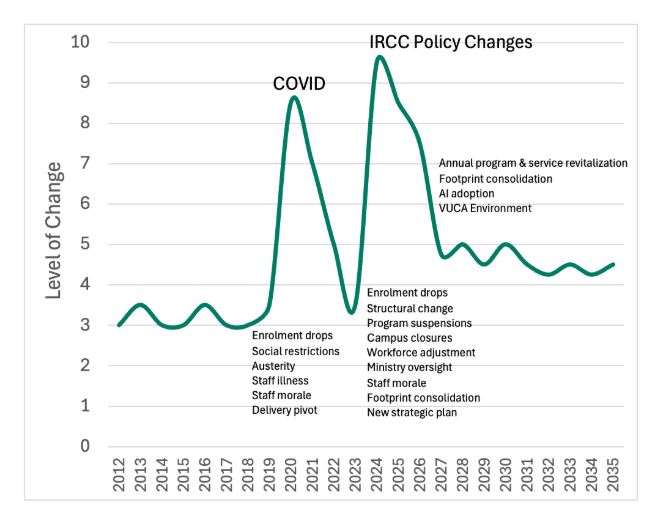
In this chart, I’m using a scale from 0 (no change) to 10 (dramatic change). In the decade before COVID, the sector experienced relatively small, regular shifts due to technology, recessions and political factors. In 2020, COVID turned our sector upside down, resulting in historic changes. By 2022, we were returning to more typical levels of change, and 2023 gave us a short breather. Then 2024 arrived, along with major shifts driven by international student policy. We’re still working through those impacts and likely will be (though less acutely) until the end of 2027. After that, based on what we know now, I expect change will be less extreme, but still greater and more frequent than in the pre-COVID decade. We’ll need to build our capacity to be resilient, to anticipate change, and to prepare for it.
As you know, the changes we’re making aren’t limited to classrooms and programs. We’re also reshaping services and administration so the responsibility for long-term sustainability is shared across the college. That includes taking a hard look at how we organize our work and where we can streamline processes. It also includes moving to a more entrepreneurial approach to programming and operations.
What isn’t going to end is the practice of reviewing, revising and refreshing our programs and services. That’s just part of being a sustainable, responsive college, not a symptom of instability. In the past, we tended to let programs and activities accumulate without necessarily making room for new offerings or exploring efficiencies. We heard loud and clear during our strategic planning consultations that this had led to “being stretched too thin.” It also meant that every program suspension or organizational change prior to 2020 felt like a major shock to the system. Going forward, we’ll build in time for intentional, transparent reviews so that sunsetting some programs and services to make space for more relevant ones becomes a normal and expected practice.
We’re also shifting more energy toward revenue-generating opportunities that align with our mission. That includes applied research that serves our region, our country and the world; continuing education that anticipates and responds quickly to employer needs; and ancillary services that not only support students but also generate income from communities and partners. Together, these efforts will contribute toward safeguarding our long-term fiscal health and building our status as a hub for regional education and innovation.
Despite the major changes we’ve seen in the last two years, our purpose remains the same: Together we inspire generations of changemakers through relevant, inventive and sustainable education. We’re still committed to sustainability; equity, diversity and inclusion; reconciliation; research and innovation; and wellness. I know the decisions we’re making now are painful; nobody wants this. We’re heading into a future where volatility, uncertainty, complexity and ambiguity (VUCA) aren’t necessarily exceptional conditions anymore. The changes we’re making now will help us become a high-performance, high-support organization that can adapt and grow, rather than just react.