FAQs: International Policy Changes, Labour Adjustments and What Comes Next
Changes by Immigration, Refugees and Citizenship Canada (IRCC) affecting international student recruitment are leading to questions around enrolment numbers, labour adjustments and how Selkirk College will navigate the changing post-secondary landscape.
We have compiled some frequently asked questions and provided answers. This is a dynamic situation, and these FAQs will be refreshed as new information becomes available. Please check back for updates.
You can also read FAQs compiled for an external audience on the public website.
Updated May 5, 2026*
*This information is accurate as of May 5, 2026
What’s happening with the Tenth Street Campus?
We are currently working with the City of Nelson to renew our lease for the Tenth Street Campus. No decision has been made to close the campus. At the same time, we need to review how we use all our facilities as part of our financial sustainability mandate. This work will be part of an updated Campus Master Plan, which we’re starting this spring. The process will take about a year and will include consultation with the college community.
Past master plans have explored the idea of bringing programs and services together on one campus in Nelson. This would not only reduce operating expenses but also increase the level of services and amenities that students can access on a single, more populated campus. That idea will be considered again alongside other options. If consolidation is found to be the most appropriate course of action, it will take time and involve detailed planning, including how to support programs, services, and people through any transition.
Please keep an eye on the newsletter for opportunities to get involved in the consultations.
Why have there been some title changes in the leadership team?
Two leadership titles have been updated to better reflect common practice across the post-secondary sector: The Vice-President, Education and Students, is now Vice-President Academic and Provost; and the Vice-President, College Services, is now Vice-President, Finance and Corporate Services.
There are no changes to compensation because of these title updates.
Why did the Associate Vice-President, Student Success, role change to a Vice-President, Students and External Relations?
Over the past few years, the college’s external-facing work has expanded significantly, especially as we respond to the loss of international student revenue and increased scrutiny from government and communities. We’re spending more time than ever before on government relations, advocacy, partnerships, fundraising, revenue generation and reputation management, on top of student recruitment and marketing.
Until now, this work sat directly with the President’s Office and a few senior leaders. The volume and complexity have reached a point where it’s no longer realistic or effective to manage all of this without a clearly defined senior role leading it. We need to have enough leadership capacity focused on the external relationships that directly affect our funding, enrolment, and long-term stability. For that reason, existing responsibilities have been reorganized under a Vice-President, Students and External Relations, bringing student services, recruitment, marketing, communications, advancement, continuing education and external partnerships into one coordinated portfolio. This is intended to improve how we support students, respond to government and community expectations, and develop new revenue sources for the college.
The change doesn’t add a new position or increase the size of the executive team. It is a reclassification and realignment of an existing role so that our leadership structure better reflects the work we’re expected to do.
Did we balance the budget for the 2027 fiscal year?
Yes. At its March 2026 meeting, the Board of Governors approved a balanced $68.9 million budget for fiscal year 2027 (FY27). This number reflects a drop in both revenues and expenses relative to the years before IRCC policy changes drastically reduced the number of international students we can recruit.
Achieving a balanced budget required significant planning and strategic decision-making to address what remains a very demanding and complex operating environment. We continue to face ongoing inflation, lower international student revenue, demographic challenges and broader financial pressures. Balancing our budget has been difficult, and we’re grateful to everyone who has supported these challenging but necessary efforts to secure a financially sustainable future.
What changes were needed to balance the budget for FY27?
Balancing the coming year’s budget required a combination of strategic decisions, including:
- Targeted cost reductions, including a 5% workforce reduction
- Better alignment of expenditures with revised revenue projections
- An increase in project-based funding (outside our government block-grant) for high-demand and strategic areas, including health and human services, trades training, and pathways programming
- An increase in entrepreneurial orientation (i.e., revenue generation goals)
- Institutional strategies that support a 5% increase in domestic student enrolment
- Careful management of resources while protecting core priorities and services
These decisions were made in response to a significantly changed financial landscape this year, including a projected 64.3% decline in international tuition revenue ($6.9 million) by the end of March 2027.
What was the number of workforce reductions for 2025/26?
Workforce reductions include layoffs, contract non-renewals, early retirements, voluntary reductions in work, and decisions not to backfill vacant positions. Because these changes occur across multiple employee groups and collective agreements, final numbers depend on the completion of several required processes, including notice periods, employee placement, and reassignment reviews.
These processes are still underway, and confirmed totals will be available closer to the end of May.
How are employee compensation costs reflected in the budget?
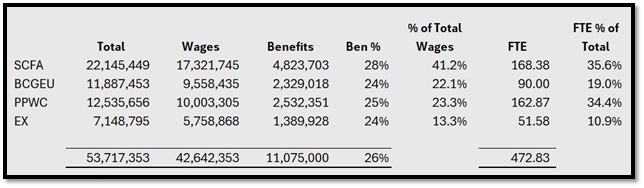
Employee compensation remains the college’s largest expense in the FY27 budget. Of the $68.9 million total budget, $47.9 million is for compensation, supporting about 417 FTE positions across the college.
Compensation can be broken down into two parts: $37.8 million in wages and $10.1 million in benefits. The distribution is based on staffing levels, collective agreements, benefit commitments and operational requirements. Table 1 reflects the compensation expense for FY2025 by employee group.
Table 1: Selkirk College Compensation Distribution by FTE, 2025
To balance the FY27 budget, the college had to reduce its salaries and benefits expense by 5%. We recognize that workforce reductions have a real impact on people and teams; please know these decisions were not made lightly.
It’s our hope that as we regain financial sustainability, we’ll be able to reinvest in people, programs and services again in a carefully managed growth strategy.
How will the latest budget impact my department or area?
Impacts may vary across departments and areas, depending on operational needs, funding sources and strategic priorities. In many cases, this year’s budget reflects adjustments that have already been planned or implemented (e.g., based on decisions made last year).
We’ve tried our best to make decisions thoughtfully, manage change responsibly and communicate regularly. We encourage employees with questions about specific impacts to their department or area to speak with their supervisor or senior leader for more information.
Why is the Board of Governors moving to quarterly meetings?
As part of our commitment to greater efficiency and effectiveness across the college, the board recently decided to move to quarterly meetings (from seven) plus an annual retreat. This aligns with widely accepted practice in higher education and the public sector, especially for mature organizations like ours. Governance research highlights that holding more frequent meetings doesn’t necessarily correlate with greater board effectiveness. It increases the workload on staff and governors and leaves less time for leaders to carry out core operational responsibilities.
These quarterly meetings are guided by a clear annual work plan and committee structure, so the board will still provide strong, regular oversight and transparency. This will result in less duplication, a greater focus on foresight instead of hindsight, and a more sustainable workload for both employees and governors. That supports the college’s overall health, which is in everyone’s interest.
Updated: April 14, 2025*
*This information is accurate as of April 14, 2025
Did Selkirk College agree to a 24-month recall period, instead of 15 months, making an exception (as requested by the Selkirk College Faculty Association) to the current collective agreement?
Yes, the college agreed to the extension of the recall period as per Article 5.9, from 15 months to 24 months. It is understood that this temporary variance will not apply to any future layoff notices during the term of the current agreement or until such time as its renewal.
How many employees has Selkirk College had to lay off to date?
To date, there has been an identified reduction of 41.8 full-time equivalent positions from all employee groups across the college. This includes layoffs, contract non-renewals, early retirements, voluntary work reductions and decisions to not backfill vacant positions.
Will there be more layoffs?
We will likely have to announce additional layoffs later this year, as international students who enrolled before the federal policy changes complete their courses and graduate. We estimate the number of international students enrolled with us will fall to 350 in September 2025, and then to 150 in September 2026. While we’re implementing new strategies to build domestic enrolment, the number of domestic students won’t rise quickly enough to make up the revenue difference.
What is the college doing to increase domestic enrolment?
We have two main strategies. First, we’re developing a strategic enrolment management (SEM) plan that aligns closely with the strategic plan. It has measurable goals we can monitor to make sure we’re on track. Second, the Communications and Public Engagement team is adjusting its focus to prioritize attracting domestic students. The team is building a marketing and communications plan in alignment with SEM. It is also launching a visual identity refresh project to better target prospective students with a unique value proposition that aligns with the strategic plan.
Has Selkirk College made any changes to community access?
Due to unprecedented levels of financial constraint, the college has had to make the difficult decision to close the learning centres in Kaslo and Nakusp. We will be consulting with the community to explore other potential models of providing access to training and education.
Updated: March 17, 2025*
*This information is accurate as of March 17, 2025
Why isn’t the college making business accounting courses available to domestic students?
We have several business course and program options for domestic students in Office Administration, Professional Management & Accounting Finance.
Spring intakes of Business Administration Accounting Finance – Diploma and Business Administration Professional Management – Diploma have been suspended due to low enrolment. However, applications are open for fall 2025 and winter 2026.
The School of Business is exploring what's next for the domestic market. The Education Council has approved in principal a new Advanced Certificate in Entrepreneurship.
A recent article in the news mentioned layoffs, but there was no mention of layoffs within the exempt employee pool. Was that simply because the article focused on the unions?
That article directly responded to a media release about the college’s first round of layoffs, which was restricted to BCGEU. That particular area was where the impact of fewer international students was the most immediate.
In an earlier town hall and other communications, we have touched on the need for a phased approach to layoffs because of the ripple effects of declining enrolment. Some of these developments aren't immediately obvious and won't come into play until the current international student cohort starts to graduate. Some decisions are simply taking more time because we need to follow due process.
We expect all employee groups will be affected in subsequent phases.
I heard a radio ad about the layoffs that said Selkirk College refused to comment. Why aren't we talking to the media?
We're committed to being as transparent as possible with our community—both employees and the greater college community.
It’s a constantly evolving situation, and it's important to make sure the information we're sharing is correct, because this news deeply impacts individuals.
We want to reduce the potential of accidentally being misquoted or misinterpreted in a face-to-face or an on-the-spot interview, so we're providing written updates to the media. Whenever we share new information, we update our internal or external FAQs and newsfeed, depending on the appropriate audience. We will also respond to individual media questions by email.
We're not doing spoken interviews right now. We may revisit that, but for now, that's how we’re increasing the likelihood that the media shares accurate information.
What measures is the college taking to ensure that it's not only instructors and faculty being laid off but that there is an equitable and proportional workforce reduction or other cost savings that do not involve personnel reductions?
We’re taking several measures. For example, we’re conducting a comprehensive budget review across all areas, services and departments, and looking at scenarios to reduce overall expenses by $9 million. We’re exploring implementing more operational efficiencies—like adjusting service offerings and organizational activities—and shifting our business processes where possible.
We’re exploring ways to reduce our physical footprint to optimize resources. This process has started with moving all the programs operating out of the Applied Research & Innovation Centre (ARIC) to other campuses.
We’ve also adopted a strategic hiring process (as opposed to a hiring freeze). Executive leadership is reviewing all new vacancies—in consultation with the affected department or area—to determine whether the position will be filled.
Are the figures and numbers outlining the cost savings represented from this round of layoffs and in relation to the overall deficit available? If not, when will they be and or will they be?
We’ll share this information as soon as we can. We need to ensure that people who are impacted are informed first. We’re canvassing and working through contracts, including what's renewed and what changes are being made. We’ll bring the budget forward in May. By that point, we’ll likely be able to share that information.
Even though there's a reduction in program offerings, are these cuts being decided with an eye to rebuilding? Are the new strategic plan program review recommendations and operational plan recommendations considered in determining what programs and courses to cut?
The initial intake suspensions were directly related to the reduced international student numbers. Those decisions were really based on courses and programs that no longer have students applying. Those schools and programs will be engaging in a review and renewal process, aligning with the new strategy and local labour market needs.
As we explore further efficiencies, decisions will be based on the new strategy program, review, labour market trends and strategic enrolment management.
Is Selkirk College slowly headed toward becoming a vocational school? What is the commitment to academic and university transfer programs?
We're not moving toward becoming a vocational school. We remain committed to providing a continuum of education for students, including everything from trades to arts and university arts and science to community education and workplace training.
We have no plans to transition to a vocational school.
Why are we spending money on a new logo at a time of fiscal restraint and layoffs?
In 2023, when we started talking about the new strategic plan, the Selkirk College Board of Governors requested a visual identity refresh at the same time. The idea was to develop a fresh and contemporary logo to support our new vision and help us appeal to a broader audience.
Even before the changes to federal immigration policy, we were looking at ways to increase domestic enrolment. The current crest is rich in history, and it does have good local recognition, but it doesn’t capture the innovative, experiential and inclusive identity we want to project in line with the new vision.
The visual identity refresh is an investment, but it's part of exploring new approaches to promoting the college and its programs. And if we are going to be paying for marketing media that will be around for a while, we want to make sure it's consistent with our new strategy
Is Selkirk College willing to commit to a 24-month recall period instead of 15 months, even if it's outside the current collective agreement?
Human Resources is considering this request.
Is there a link that details the national labour force needs?
Explore the Classification of Instructional Programs (CIP), which are used to classify post-secondary education programs according to field of study requirements.
I’ve been seeing capital purchases and renovations around the college. Why are we still doing this in a time of fiscal restraint?
We actually have two “budgets”: one is for operations, and one is for capital (which must be spent on infrastructure and related items). And sometimes, we’re fortunate to be awarded grants or one-time funding opportunities that must be spent on specific projects. For example, we’ve been generously supported by the Columbia Basin Trust with an annual grant of $1M, which must be spent on projects (not operations) that improve student experience and outcomes and aren’t covered by our core funding. This is why you may be seeing some new infrastructure, such as the library pods or Pit renovations. These funds are not coming out of our core operations, and they can only be spent on things that were approved by the funder.
Updated: February 19, 2025*
*This information is accurate as of February 19, 2025
In December, I heard the deficit would be $8 million. Now, I’m hearing it could be $9 million. Why are the numbers changing?
This is a fluid situation. The deficit number depends on current enrolment as well as anticipated reductions that will come from having fewer students. We will continue to keep you informed on the projected deficit as we get more information.
When will more information about labour adjustments be shared?
We’re sharing as much as we can when we can. We have to make sure we’re not compromising confidentiality, we’re following our communication protocols, and we’re adhering to collective and employment agreement terms and conditions.
What if the media approaches me with questions about labour adjustments, enrolment numbers and the impact of changes to federal immigration policy?
If someone from the media contacts you, please forward any queries to Maggie Keczan, director of communications and public engagement.
It’s important that we share accurate information that doesn’t compromise confidentiality or violate the terms and conditions of any collective or employment agreements.
Have any more programs been suspended?
Currently, we have suspended intakes of the following programs. Please visit the program pages for information about which intakes have been suspended.
- Accounting – Postgraduate Diploma
- Business Administration Accounting Finance – Diploma
- Business Administration Professional Management – Diploma
- Business Management – Postgraduate Diploma
- Culinary Management – Postgraduate Diploma
- Full-Stack Web Development – Postgraduate Diploma
- Gerontological Nursing – Postgraduate Diploma
- Hospitality Management – Postgraduate Diploma
Updated: January 28, 2025*
*This information is accurate as of January 28, 2025
Are we responding to these external pressures at the right pace?
There’s no universal right or wrong pace for situations like these. For some people, we know decisions are being made too quickly, and for others, those decisions are coming too slowly. We’re doing the best we can to make thoughtful, transparent decisions that are neither rushed nor delayed and are based on the best information we can gather. That being said, we’re always open to feedback on improving our decision-making and communications processes—please get in touch with your union representative or immediate supervisor with any ideas so they can share them with us.
Why haven't we implemented a hiring freeze?
We are following a “hiring review” process instead of implementing a hiring freeze. We need some positions to maintain basic service levels regardless of operating deficits (e.g., payroll), so a blanket hiring freeze wouldn’t serve us well. All new postings go through an executive leadership review process to determine whether we’ll fill a new or vacant position, in consultation with the affected department or area.
Original Questions: December 17, 2024*
*This information is accurate as of December 17, 2024
What is happening with international student enrolment?
In January 2024, Immigration, Refugees and Citizenship Canada (IRCC) placed a cap on international student enrolment. This cap was in response to the federal government's change of direction regarding targets set on immigration, and the actions of some bad actors in the Ontario and private college sector. For Selkirk College, this meant we’d be able to recruit about 200 fewer international students (our new maximum would be 750) than our peak number in 2018/19. This policy change sent a message to overseas markets that Canada was becoming less open to international students. The impact on our college would have been challenging but manageable over the next few years.
This past fall, IRCC made several more changes. Among the most impactful were the restrictions on post-graduation work permits (PGWP) for college graduates and the removal of the Student Direct Stream, which expedited student visa processing for certain countries. The PGWP change is largely responsible for the dramatic drop in international student applications. It means that college graduates can only apply for a PGWP if they graduate from certain programs that align with national (not regional) job market demands, such as health, engineering and agriculture. Graduates in hospitality and tourism, business, and university arts and sciences (which the majority of international students at Selkirk College study) are no longer eligible.
International students typically come to Canadian colleges because education is the first step on a pathway to permanent residency (PR). They can get Canadian job training, which then leads to a PGWP (i.e., Canadian work experience), which, in turn, facilitates PR. Removing the ability to get a PGWP makes it much more challenging for students to get PR, so they may choose to go to university or another country instead. In addition, the negative rhetoric and public discourse have damaged the Canadian education brand, with the result that among students abroad, Canada has dropped from first choice to fourth since last year. Students planning to study abroad want stability, predictability and safety, and these things are now in question in the Canadian landscape.
Have we suspended or cancelled any programs as a result of the IRCC reforms?
We have suspended intakes of the following programs:
- Culinary Management – Postgraduate Diploma
- Accounting – Postgraduate Diploma
- Business Management – Postgraduate Diploma
- Hospitality Management – Postgraduate Diploma
- Postgraduate Diploma in Gerontological Nursing
Do the IRCC changes affect international students who arrived before November 2024?
Most of these changes apply only to international students starting in January 2025 and later. For students who arrived any time before November 2024, the main changes are:
- They can no longer work 40 hours per week while attending classes. The limit is 24 hours per week.
- They will need to write another English proficiency test before receiving a work permit.
Students who arrived prior to November 2024 may still be eligible for work permits upon graduation, even if their field of study does not align with national labour demands. For the most up to date information, please visit IRCC.
What is the timeline for labour adjustments?
We are still working through the final details on which areas will be affected. Prior to the holidays, deans will be reaching out to some employees for preliminary workload discussions. Deans and directors will meet with SCFA and BCGEU employees who may be impacted by labour adjustments in advance of the targeted canvass that will take place January 15-29, 2025. The purpose of the targeted canvass is to identify volunteer solutions that may provide viable options to reduce the number of potential layoff notices in the targeted areas.
Layoff notices will be issued following the canvass period, as outlined within the applicable collective agreement, after all volunteer solutions have been considered. As noted previously, all current short-term and non-regular contracts will be honoured through the end of their term.
This contraction will then create ripple effects that lead to a second phase of layoffs in spring/summer 2025 for all other areas and employee groups of the college. There will likely be a third phase in late 2025/early 2026 as our current cohort of international students completes their education and we start to see the full effects of the IRCC restrictions. Throughout this period, we’ll be working to ensure ongoing supports for affected employees.
What’s happening to the ideas we’re submitting for mitigating impacts of these changes?
Deans, directors and union leadership are sharing ideas with the executive leadership team. You can also meet directly with Taya, Lareena or Brier with suggestions. The executive team includes Maggie M., Lareena, Taya, Brier and Stacey. They meet frequently to discuss enrolment updates, people and program impacts, as well as suggestions from the college community.
This FAQ document, which will be updated regularly, is an idea from our college community. Furthermore, there is a list at the end of this document where we provide responses to the suggestions you’ve submitted to date.
Why can’t we just cut expenses down to the bone to avoid layoffs and just hang on until this passes, like we did during COVID-19?
We continue to see cost savings from some of the process changes made during COVID-19. However, there are fewer opportunities for reducing expenses now, and it’s harder to find ways to do this without seriously impacting our culture, the quality of education we provide and our ability to operate effectively.
The reality is that we’re looking at an $8M deficit next year, and no amount of discretionary cost cutting will address that. In addition, the enrolment impacts of these IRCC decisions are larger and will have longer-term impacts than COVID-19. We are unlikely to see student numbers recover for at least the next three to five years because the damage to “Brand Canada” has been done. And while domestic enrolment is rising slowly, it’s not enough to fill the gap left by lower international enrolment. Unlike many other colleges, we don’t have an unrestricted accumulated surplus we can draw from to help us manage our cash flow. If we don’t reduce our staffing levels to better align with actual enrolment, we may not be able to meet our financial obligations.
Why aren’t you marketing my program to boost enrolment right now?
We understand the impulse to boost marketing and recruitment efforts right now, especially for those programs facing challenges.
However, we're at a critical juncture, where hasty promotional efforts distributed across many programs would likely yield minimal results, especially given our limited resources. Instead, we're taking a step back to develop a more strategic, targeted approach. This will allow us to:
- Identify which programs have the most potential for growth or recovery
- Allocate our limited resources more effectively
- Create more impactful campaigns that are likely to get better results
We believe this focused strategy will ultimately benefit more programs in the long run, rather than spreading our resources too thin across all programs. We're committed to supporting our faculty and programs, and this approach gives us the best chance of doing that successfully.
Why isn’t the provincial government helping us?
The provincial government has been working very closely with the colleges to learn the impacts of these changes. They are advocating that the federal government pull back on some of the policies hurting colleges in particular. In terms of financial assistance, the government is facing a deficit of $9B this coming year and a debt of over $70B, and we are not getting any signals that additional core funding is coming. While normally, colleges are not allowed to submit a deficit budget, the government began allowing this during COVID-19 and may allow us to continue doing this if we can provide a plan to achieve a balanced budget over the next few years. Selkirk College’s projected deficit for 2025/26 is about $8M, based on a $65M budget.
Are these changes impacting management and exempt positions, or just union positions?
All employee groups at the college will be affected. We anticipate a first phase of layoffs of mostly student-facing roles linked to the decline in international enrolment. This will create ripple effects that lead to a second phase of layoffs in spring/summer 2025 for all other areas and employee groups of the college. There will likely be a third phase in late 2025/early 2026 as our current cohort of international students completes their education and we start to see the full effects of the IRCC restrictions. Throughout this period, we’ll be working to ensure ongoing supports for affected employees.
What is Selkirk College actually doing about this? It doesn’t seem like there’s any action to prevent layoffs.
We understand the frustration and anxiety this situation is causing, but it’s important that we make thoughtful, strategic choices, as opposed to hasty, more reactive responses.
These are unusual circumstances, with ongoing immigration policy announcements sending us back to the drawing board each time. We’re also trying to make the most accurate assumptions possible around application numbers for 2025/26, and we won’t get a sense of that until late fall/early winter.
The unavoidable fact is that if we don’t have as many students, we don’t need as many staff. Our region’s slow growth and aging population make domestic recruitment increasingly challenging, and we haven’t yet been able to promote a distinctive identity that would attract students from outside the region. Our new strategy, with its focus on linking all of our programs to a sense of land and place, will help us with that, but it will take several years to get there.
Members of the executive leadership team meet daily on these issues, sharing new information, building scenarios and considering new ideas that might help us reduce the impact of the situation. We’re also advocating to be treated the same as the universities (i.e., for college graduates to qualify for post-graduation work permits without being restricted by program).
We’re being as transparent and forthcoming as we can, and we appreciate your patience as we work our way through this.
College Community Suggestions
Thank you everyone, for putting thought into some innovative ideas to mitigate future layoffs. We really appreciate your level of engagement in this process. As you know, we’re currently facing resource constraints that will limit our ability to immediately implement all of these ideas. Our finances and workforce are in transition, making it really challenging to act on many of these suggestions right away. That being said, we’re saving all the ideas we’ve received as many of them could be implemented to support our strategic plan in the future.
In the meantime, the executive leadership team is looking at all of the ideas to:
- Identify and prioritize low-resource, high-impact proposals
- Explore phased implementation of ideas that align with our strategy
Our immediate focus needs to be on solutions that can be implemented quickly and with minimal additional resources. We'll keep you updated on implementation possibilities as our resources become clearer.
Ideas we’ve received to date include:
1. Cut professional development (PD) to save money.
2. Cut travel and move to virtual meetings.
3. Suspend the computer loan and e-bike program.
4. Create a new program in “X” to meet emerging demand.
5. Suspend college staff and team events.
6. Strengthen relationships with local high schools to bolster recruitment.
7. Promote retention and recruitment by providing more on-campus activities and extending facility hours.
8. Expand online offerings and partner with international institutions.
9. Offer more scholarships to promote domestic enrolment.
10. Offer flexible payment plans to make it easier for students to pay for college.
11. Strengthen community partnerships with more co-op opportunities and apprenticeships.
12. Promote greater alumni engagement to encourage more donations.
13. Increase the number of permanent recruiter positions.
14. Increase marketing and the types of promotional events we go to.
15. Allow the community learning centres to admit students.
16. Offer new continuing education and modular courses, boot camps, and summer sessions.
17. Generate revenues by offering catering or other services (as part of our educational offerings) to the community at large.
18. Engage in new marketing and recruitment strategies – college wide and program specific.